AI-Ready eCommerce Development Built to Sell, Scale & Get Discovered
Build more than an online store. We design and develop high-performing eCommerce experiences for D2C, B2B and marketplace businesses — combining conversion-focused storefronts, secure checkout, custom integrations and practical AI capabilities that help customers discover, compare and buy with less friction.
From Shopify and WooCommerce to custom and headless commerce, iTechOza can help you launch a new store, modernize an existing platform or build complex commerce workflows around the way your business actually sells.
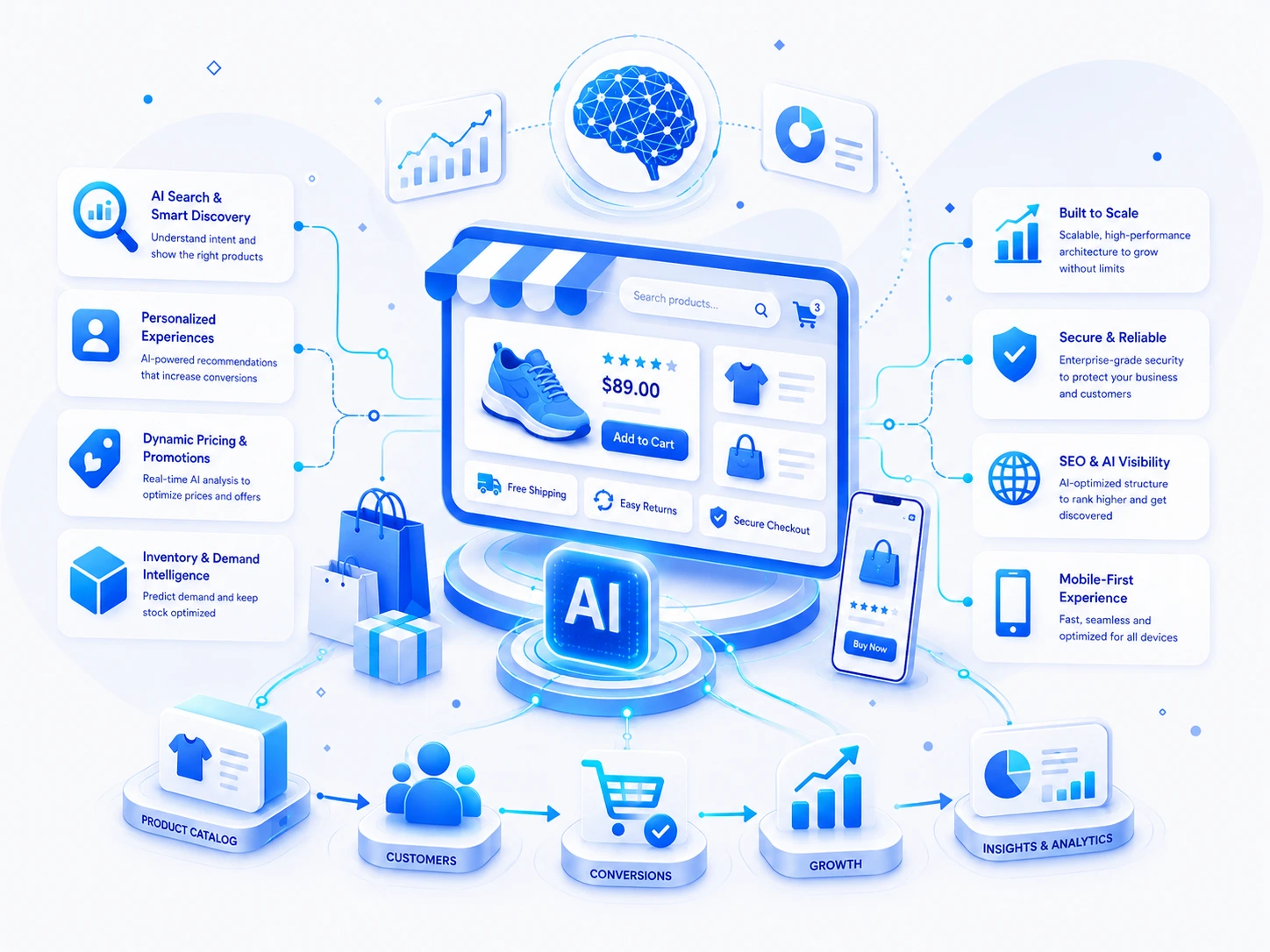
Your Next Customer May Discover You Through Search, Social — or an AI Conversation
The storefront still matters, but the buying journey no longer starts in one place. Customers discover products through Google, creators, marketplaces, social content and AI assistants. They expect fast answers, accurate availability, relevant recommendations and a simple path to checkout wherever that journey begins.
That creates a new development challenge: your eCommerce platform has to work beautifully for people while keeping product, price, inventory and policy data structured enough for search engines, feeds, integrations and AI systems to understand.

Hard-to-Find Products
Weak search, poor filters and thin product data make high-intent shoppers leave before they find the right option.

Slow Mobile Shopping
Heavy themes, unnecessary scripts and clumsy mobile UX create friction at the exact moment customers are ready to buy.

Disconnected Operations
Inventory, orders, CRM, shipping and customer data living in separate systems lead to manual work and inconsistent experiences.

Generic Experiences
One-size-fits-all merchandising misses opportunities to personalize discovery, bundles, offers and repeat purchases.

Checkout Friction
Unexpected costs, limited payment options and long checkout flows can turn purchase intent into abandonment.

Invisible to AI Discovery
Incomplete or inconsistent product data can make it harder for AI-powered search and shopping experiences to understand and recommend your catalog.
Add AI Where It Improves the Shopping or Operating Experience
We do not add AI just to put an “AI-powered” badge on your store. We identify where intelligence can remove friction, improve product discovery, reduce manual work or help your team act faster — then integrate it into a reliable commerce foundation.
Conversational Product Search
Let shoppers describe what they need in natural language — such as “a waterproof work backpack under $120 with a laptop sleeve” — and return relevant products using catalog attributes, search logic and AI.

AI Shopping Assistant
Guide customers through product questions, comparisons, sizing, compatibility, policies and common purchase decisions while handing complex cases to a human when needed.

Personalized Recommendations
Use browsing, cart, purchase or preference signals to surface more relevant products, bundles, replenishment options and cross-sells where the available data supports it.
AI-Assisted Merchandising
Support your team with product tagging, category suggestions, description drafts, enrichment and catalog cleanup — with human review and brand controls.

AI-Readable Product Data
Structure product attributes, availability, pricing, variants, shipping and return information so search engines, feeds and emerging AI shopping surfaces can understand your catalog more reliably.

Agentic Commerce Readiness
Where the platform and market justify it, prepare APIs, product data and checkout workflows for emerging standards such as UCP and ACP without rebuilding your entire commerce stack.
eCommerce Solutions Built Around How You Sell
Different commerce models need different workflows. We design the platform around your catalog, customers, pricing, fulfillment and growth plan instead of forcing every business into the same template.
D2C eCommerce Stores
Brand-led storefronts with mobile-first product discovery, promotions, subscriptions, loyalty, analytics and conversion-focused checkout.

B2B & Wholesale Portals
Account-specific catalogs and pricing, quote or approval workflows, bulk ordering, purchase orders, credit terms and multi-user business accounts.

Multi-Vendor Marketplaces
Vendor onboarding, product moderation, commissions, payouts, order routing, seller dashboards, reviews and marketplace administration.
Subscription Commerce
Recurring products, memberships, replenishment, flexible billing, account management and retention-focused customer journeys.
Custom Commerce Platforms
Purpose-built storefront, backend and admin workflows for business models that do not fit standard platform constraints.
Mobile Commerce & PWA
Fast mobile storefronts and app-like web experiences, with native mobile development available when the use case requires deeper device features or retention loops.
End-to-End eCommerce Development Services
Whether you are launching, migrating, integrating or scaling, our team can support the full commerce lifecycle from architecture and UX to backend workflows and post-launch improvements.

Custom eCommerce Development
Build a commerce platform around your exact products, pricing, users and workflows when off-the-shelf platforms become restrictive.
Included capabilities
- Custom storefront and checkout flows
- Product, category and variant architecture
- Customer and admin dashboards
- Custom pricing, promotions and business rules
- API and backend development
- Scalable database and cloud architecture

Shopify Development
Launch or improve a Shopify storefront with custom UX, app integrations and platform-specific development for growing retail and D2C brands.
Included capabilities
- Store setup and custom theme development
- Shopify customization and feature development
- Product and collection architecture
- App and API integrations
- Checkout and conversion improvements
- Migration to Shopify where appropriate

WooCommerce Development
Use the flexibility and ownership of WordPress/WooCommerce with custom development, performance work and deeper integration support.
Included capabilities
- Custom WooCommerce stores
- Theme and plugin customization
- Payment and shipping integration
- Subscription and membership workflows
- Performance and database optimization
- WooCommerce maintenance and troubleshooting

Headless & Composable Commerce
Separate the storefront experience from the commerce engine when your business truly needs greater frontend control, multi-channel delivery or specialized performance.
Included capabilities
- Next.js / React storefronts
- API-first commerce architecture
- Headless Shopify or WooCommerce
- CMS / PIM integrations
- Server-side rendering and caching strategy
- Independent frontend release workflows
Marketplace Development
Create multi-seller commerce platforms with the operational controls needed to manage vendors, commissions, orders and payments.
Included capabilities
- Vendor onboarding and verification
- Vendor dashboards and catalog management
- Commission and payout logic
- Multi-vendor order management
- Ratings, reviews and moderation
- Admin controls and reporting
eCommerce Integrations & Automation
Connect the systems behind the storefront so orders and customer data move with less manual work.
Included capabilities
- Payment gateways and digital wallets
- ERP, CRM, PIM and POS integrations
- Shipping, fulfillment and tracking
- Tax and invoicing workflows
- Marketing and analytics platforms
- Custom third-party APIs and webhooks
Migration & Replatforming
Move from a restrictive, slow or difficult-to-maintain platform with a structured migration plan designed to protect business continuity and organic visibility.
Included capabilities
- Catalog and customer migration
- Order history migration where feasible
- URL mapping and redirect planning
- SEO and structured-data checks
- Integration recreation or replacement
- Staged cutover and launch verification

eCommerce Maintenance & Growth Support
Keep the store reliable after launch while improving features, integrations, performance and conversion journeys over time.
Included capabilities
- Bug fixing and technical maintenance
- Feature enhancements
- Payment / API troubleshooting
- Speed and Core Web Vitals improvements
- Catalog and search enhancements
- Ongoing development capacity
The Features Customers See — and the Infrastructure Your Team Depends On
A high-performing eCommerce system is more than a homepage and a checkout button. We engineer the customer-facing journey and the operational workflows behind it so your store remains usable as products, orders, channels and integrations grow.
Catalog & Product Experience
Categories, variants, attributes, bundles, related products, comparison, rich media, specifications and product content.
Search, Filters & Discovery
Faceted filters, autocomplete, synonyms, intelligent search, conversational discovery and category merchandising.
Cart, Checkout & Payments
Guest checkout, coupons, taxes, shipping, wallets, payment gateways, subscriptions, refunds and confirmation flows.
Inventory & Order Management
Stock visibility, order status, fulfillment logic, cancellations, returns, notifications and operational dashboards.

Promotions & Retention
Discount rules, bundles, upsells, loyalty integrations, wishlists, abandoned-cart flows, memberships and recurring orders.
International & Multi-Channel
Multiple currencies/regions where supported, localization, marketplace/social feeds and channel-aware inventory workflows.
Analytics & Measurement
Commerce analytics, conversion events, funnel measurement, consent-aware tracking and actionable operational reporting.

Security & Reliability
Secure authentication, role controls, payment-provider best practices, API protection, backups, logging and production-safe releases.
Built for Businesses That Need Commerce to Do Real Operational Work
D2C & Consumer Brands
Launch a differentiated storefront, improve mobile conversion and connect acquisition channels to a reliable purchase experience.

Retailers
Unify digital and physical commerce workflows, inventory visibility, promotions and customer experiences.
Manufacturers & Wholesalers
Build B2B ordering portals with contract pricing, account catalogs, bulk ordering and approval workflows.
Marketplace Founders
Turn a multi-sided commerce model into a platform with vendor, customer, payment and operational controls.
Subscription Businesses
Support recurring products, memberships, replenishment and account management with reliable billing workflows.
Agencies & Product Teams
Extend internal delivery capacity for commerce builds, integrations, migrations, performance work and AI features.
From Commerce Strategy to Production Launch
01
Discovery & Commerce Mapping
We understand your business model, product catalog, customers, channels, checkout requirements, integrations, operations and growth goals before locking the architecture.
02

UX, Catalog & Architecture
We plan navigation, search, product templates, cart/checkout, account flows, admin workflows, data models and integration boundaries.
03
Development & Integrations
Our team builds the storefront and backend functionality in structured sprints, connects required systems and keeps scope visible.
04
QA & Commerce Testing
We test product discovery, responsive behavior, roles, pricing, cart rules, payments, coupons, taxes, shipping, notifications, integrations and critical edge cases.
05
Launch & Migration
We prepare production, data cutover, redirects, analytics, search controls and launch verification with rollback/contingency planning appropriate to the project.
06
Optimization & Ongoing Support
After launch, we can improve performance, fix issues, add features, refine conversion journeys and support the platform as the business evolves.
A Development Partner for the Storefront, the Backend and the AI Layer
9+ Years of Web & App Development
Experience across custom web applications, SaaS, mobile, APIs, databases, integrations and production support — useful when commerce extends beyond a theme.
Full-Stack Commerce Capability
We can follow a workflow from frontend product discovery through backend business logic, database, payment and third-party integrations.
Practical AI Integration
AI is treated as an engineering capability tied to real use cases such as discovery, support, personalization, catalog enrichment and automation.
Existing Stores Welcome
We can work with inherited WooCommerce, custom and other commerce codebases after an initial review, not only greenfield projects.
Clear Scope & Communication
We define requirements, milestones and dependencies so you can see what is being built, what is blocked and what should happen next.

Long-Term Product Support
If your store needs ongoing development after launch, we can continue with defined maintenance, optimization and feature work.