Mobile App Maintenance & Support Services for Stable, Reliable Applications
Keep your React Native, Expo, Flutter, Android or iOS application reliable after launch. Our monthly mobile app maintenance services provide planned engineering capacity for recurring fixes, monitoring review, dependency and platform updates, performance checks, build support and controlled releases.
Choose a monthly care plan for ongoing support or a quarterly Mobile App Health Check for lighter preventive care. We review the codebase, release workflow and current risks before confirming the right plan and first maintenance backlog.
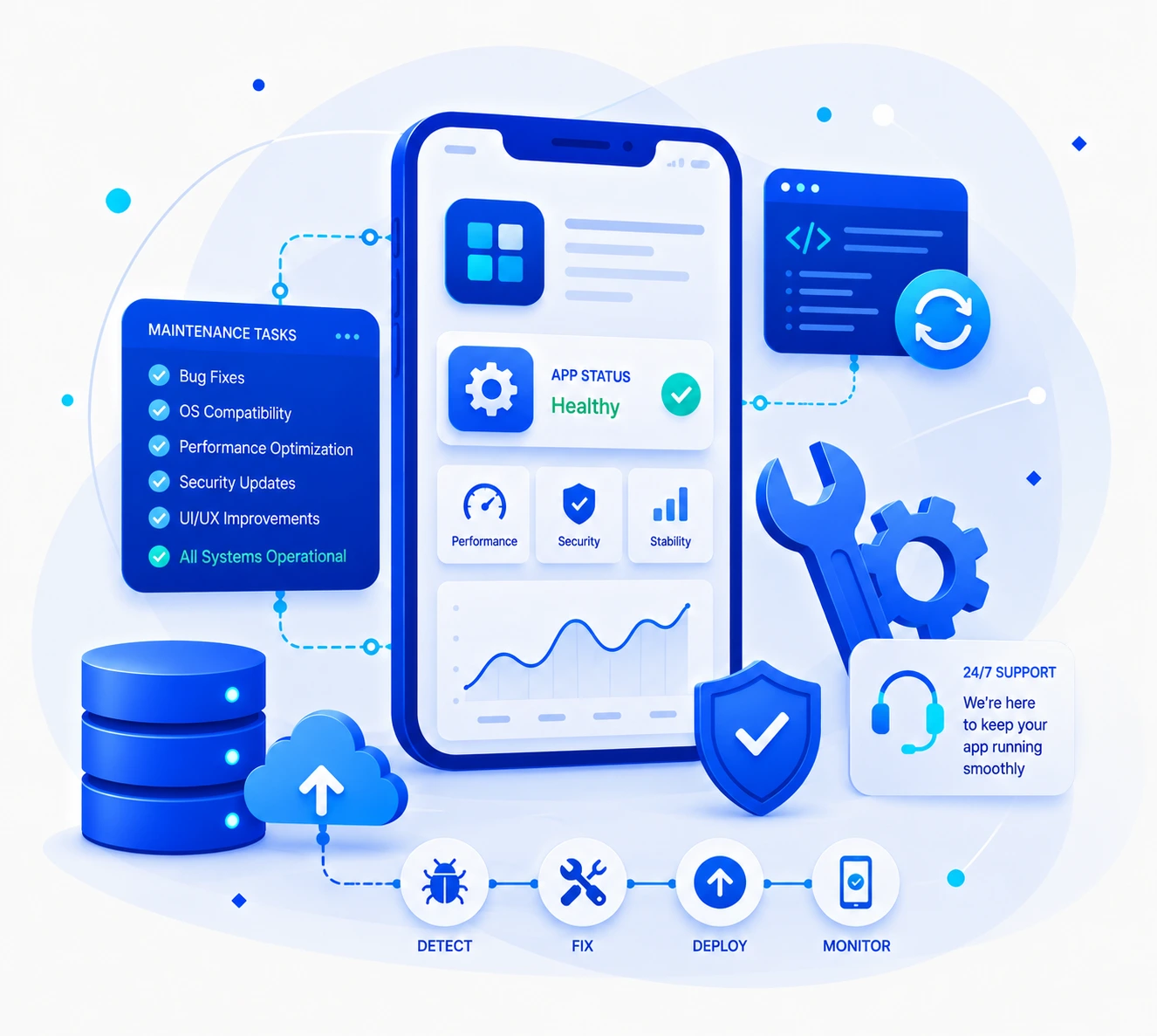
A Live Mobile App Needs Care Between Major Releases
Mobile applications operate inside ecosystems that keep moving. Android and iOS requirements change, frameworks publish upgrades, device behavior varies, third-party SDKs evolve and production data reveals issues that were not visible before launch. A monthly support plan creates a controlled way to protect stability and release readiness.

Platform Requirements Keep Changing
Target SDK rules, signing requirements, operating-system behavior, permissions and store expectations can make an unchanged app harder to build or release.

Crash and Performance Signals Need Follow-Up
Crash groups, ANRs, startup delays, memory pressure and battery concerns become useful only when someone reviews the evidence, prioritizes impact and completes approved corrective work.

Dependencies and Native SDKs Age
Framework versions, plugins, packages, CocoaPods, Gradle tooling and provider SDKs can introduce security, compatibility or release risks over time.

Small Release Problems Become Larger Backlogs
A broken notification route, unreliable login refresh or repeated build warning can keep returning until it is owned, scheduled, tested and documented.
What Our Monthly Mobile App Support Covers
We agree on the active backlog and use the selected plan's capacity on the highest-value approved work. Support may stay inside the mobile client or follow a user journey into native configuration, APIs, authentication and release tooling.

Crash, ANR and Error Monitoring Review
Turn production evidence into a prioritized reliability backlog.
- Crashlytics, Android Vitals, App Store Connect, Sentry or agreed dashboard review
- Crash-group, stack-trace and affected-version triage
- Android ANR and user-perceived stability review
- Recurring error and release-regression identification
- Approved fixes prioritized within available plan capacity

OS, Device and Store Compatibility
Keep important user journeys working as Android, iOS and store requirements evolve.
- Android and iOS compatibility review for agreed supported versions
- Target SDK, permission, background behavior and platform-policy readiness
- Screen size, orientation, safe area and accessibility regressions
- Device-specific issues using an agreed test matrix
- Technical release-readiness recommendations

Framework, SDK and Dependency Updates
Plan updates according to support status, risk, compatibility and business value.
- React Native, Expo SDK, Flutter, Android and iOS version review
- npm, Dart/Flutter package, Gradle, CocoaPods and Swift package review
- Third-party mobile SDK compatibility and deprecation checks
- Compatible patch or minor updates after approval
- Separate estimate and migration plan for major or breaking upgrades

API, Authentication and Data Reliability
Maintain the mobile-to-backend flows users depend on every day.
- REST, GraphQL, WebSocket and real-time workflow issues
- OAuth, JWT, refresh-token, session and permission behavior
- Timeout, retry, offline, caching and synchronization improvements
- File upload, media, pagination and data-mapping maintenance
- Firebase, Supabase and custom backend connectivity review
Notifications, Deep Links and Device Services
Protect workflows that depend on platform services outside the main interface.
- APNs, Firebase Cloud Messaging, tokens, payloads and routing
- Universal links, Android app links and custom URL schemes
- Camera, location, maps, files, biometrics and media permissions
- Background tasks, app-state transitions and notification actions
- Provider configuration and device-level fallback behavior

Performance, Memory and Battery Health
Investigate user-visible slowdowns using appropriate profiling and production evidence.
- Startup, navigation and interaction-delay review
- Dropped frames, rendering, image and long-list performance
- Network-call volume, caching and payload efficiency
- Memory pressure, CPU, background work and battery concerns
- Release/profile-mode checks on agreed devices when required

Build, Signing, CI/CD and Release Support
Keep the path from source code to internal testing and store submission dependable.
- Android Studio, Xcode, Gradle, CocoaPods and EAS build maintenance
- Build variants, flavors, environments and release configuration
- Certificates, provisioning, keystores and signing troubleshooting through secure access
- TestFlight, Google Play testing tracks and internal-distribution support
- Technical release notes, checklists and assisted submission within scope

Security, Configuration and Monthly Reporting
Keep technical decisions, risk and completed work visible to the client.
- Mobile configuration, secret-handling and environment review
- Dependency and SDK risk prioritization without implying a penetration test
- Permissions, privacy manifest or platform configuration review where relevant
- Completed work, capacity used, known risks and next priorities
- Release, monitoring and maintenance recommendations for the next cycle
Have a Web Project in Mind?
Whether you have detailed requirements, an early product idea or an existing application that needs to evolve, start by telling us what you are trying to achieve.
Tell Us
The Work With the Greatest User and Release Impact Comes First
At the start of each cycle, we confirm the active backlog. When an approved critical issue appears, the order can change within the available plan capacity.
Production crashes and blocked journeys
Approved problems affecting users, revenue, login, data or core workflows take priority.

Release and compatibility risks
Time-sensitive build, target-SDK, OS, signing or store-readiness work is scheduled against the agreed release calendar.

Recurring errors and device-service failures
Repeated notification, deep-link, background, API and platform issues follow next.
Framework, SDK and dependency updates
Approved update work is ordered by support status, severity, compatibility and effort.
Performance and minor product improvements
Profiling-led performance work and small UX improvements use remaining capacity after higher-risk maintenance items.
Ready to Build the Right Solution?
Whether you need a new application, additional functionality or support for an existing product, we can help you plan the right development path for your goals.
Contact UsHow Monthly Mobile App Support Works
Recurring support begins with a controlled onboarding review so we understand the app, release model, monitoring evidence and access boundaries before reserved maintenance begins.
01
Technical Fit and Secure Access Plan
We review the framework, repositories, environments, store ownership, signing model, build workflow, supported platforms and safe access requirements.
02
Baseline Mobile Health Review
We assess the current builds, critical user journeys, monitoring signals, dependencies, release risks and known issues before recurring work starts.
03

Plan and Priority Confirmation
We recommend the suitable capacity, define business hours and approvals, agree on the test matrix and create the first prioritized backlog.
04
Monthly Maintenance Cycle
We complete approved work in priority order, communicate progress and adjust the backlog when a higher-impact mobile issue appears.
05
Focused Testing and Controlled Release
Changes move through version control and the agreed build/test workflow. Production or store actions happen only with client approval.
06
Report and Next-Cycle Plan
You receive completed work, capacity used, test/release notes, known risks and recommended priorities for the next cycle.
One Support Partner Across Mobile, Native, API and Release Layers
Reliable maintenance requires context, consistency and good judgement. We learn the application over time, keep changes focused and help clients distinguish urgent work from work that can be planned.

9+ Years of Web and App Development
Experience across mobile applications, business systems, APIs, cloud services, production troubleshooting and ongoing technical support.

Cross-Platform and Native Capability
We maintain React Native, Expo and Flutter applications without ignoring the Android and iOS layers, tools and release requirements underneath them.
Backend and Integration Context
Mobile reliability often depends on authentication, APIs, data, notifications and third-party services, so investigation does not stop at the screen.
Existing and Inherited Apps Welcome
Applications built by another freelancer, agency, internal team or AI coding tool can be onboarded after a technical fit and health review.
Controlled Production Workflow
We prefer version control, least-privilege access, explicit approvals, focused verification and documented release actions.
Transparent Capacity and Reporting
The plan defines available time, initial response, scope and reporting so clients can see completed work and make informed next-step decisions.
Who Monthly Mobile App Support Is For

SaaS Founders and Product Owners
Keep the customer app stable while the product team focuses on growth, roadmap and users.
Businesses With a Live Android or iOS App
Maintain an important customer, employee or partner app without waiting for an emergency.
Lean Teams Without a Dedicated Mobile Maintainer
Gain defined technical capacity without the fixed cost of another full-time specialist.
Agencies and Development Partners
Add confidential cross-platform, native and store-release support for client applications.
Teams Inheriting an Existing App
Move an unfamiliar or undocumented codebase into a controlled support process after onboarding.
Products With Regular Store Releases
Coordinate compatibility checks, approved updates, testing and release support around a known calendar.