SaaS Product Maintenance & Growth Support Services
A live SaaS product needs more than emergency bug fixing. iTechOza provides monthly SaaS maintenance and product growth support for recurring issues, small improvements, onboarding, roles and permissions, billing journeys, integrations, performance, analytics and controlled releases.
Choose a monthly plan for reserved product-engineering capacity or a quarterly SaaS Product Health Review for lighter preventive care. We review the product, environments and active priorities before confirming the plan and first backlog.
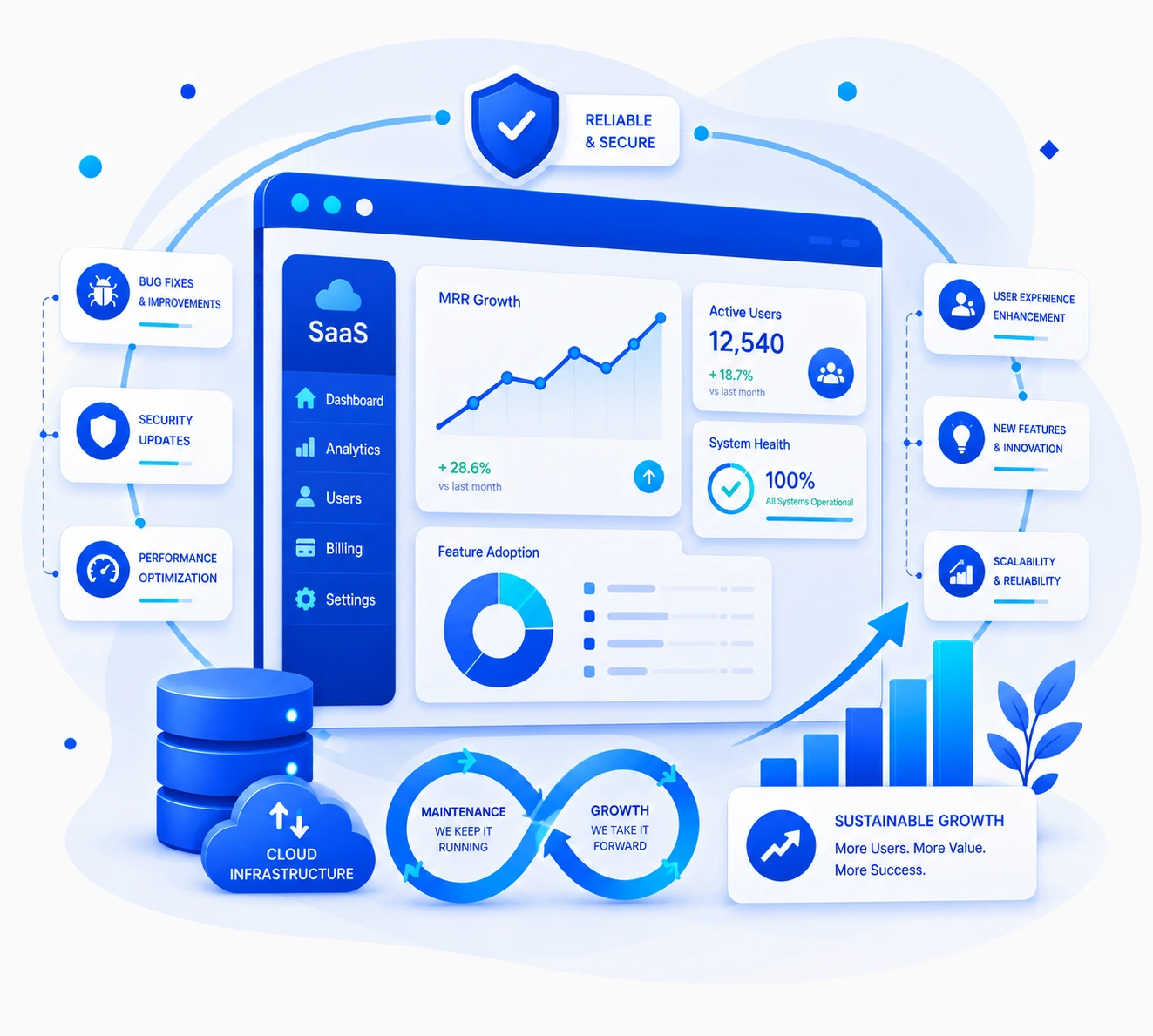
Your SaaS Product Keeps Changing Even When the Roadmap Pauses
Customer feedback accumulates, integrations evolve, billing rules become more complex and small friction points affect activation or support volume. Without consistent product ownership, teams alternate between emergencies and long periods where valuable improvements never reach users.

Recurring Bugs Compete With Product Work
Small production issues repeatedly interrupt the roadmap until they are owned, prioritized, fixed and documented through a reliable support cycle.

Onboarding Friction Reduces Product Value
Signup, invitations, workspace setup, permissions and empty states can prevent new users from reaching the useful part of the product.

Revenue and Access Workflows Grow More Complex
Trials, upgrades, cancellations, roles and entitlements must remain synchronized as plans, customers and use cases change.

Lean Teams Need Context, Not Another Handoff
A recurring team learns the product over time and can make smaller decisions with less repeated discovery than isolated freelance tasks.
What Monthly SaaS Product Support Covers
The active backlog is agreed with you and prioritized within reserved capacity. Support can follow a user journey across frontend, backend, data, billing, integrations and deployment when that context is necessary to complete the approved work.

Production Stability and Bug Backlog
Keep customer and internal workflows dependable between major releases.
- Recurring frontend, backend and database defects
- Production logs, error signals and failed-job review when configured
- Critical user-journey and release-regression fixes
- Environment-specific and data-state problems
- Focused verification and fix documentation

User Onboarding and Activation
Help new users reach the product's useful outcome with less friction.
- Signup, login, invitation and workspace-creation flows
- First-use guidance, empty states and product tours
- Email verification and lifecycle notifications
- Activation event implementation and funnel instrumentation
- Approved onboarding experiments and small UX changes

Authentication, Roles and Multi-Tenant Access
Maintain who can see, change and manage data as the product grows.
- OAuth, session, token and password flows
- Role, permission and organization membership behavior
- Tenant identification and data-isolation checks
- Invitation, ownership transfer and admin workflows
- Privileged-action and server-side authorization review

Small Product Improvements and UX
Turn user feedback into controlled incremental progress.
- Minor feature additions and workflow refinements
- Forms, validation, search, filters and reporting improvements
- Responsive, browser and accessibility regressions
- Admin and internal operational improvements
- Technical feasibility and effort guidance for larger requests
Billing, Subscription and Entitlement Upkeep
Protect the existing journey from plan selection to customer access.
- Trial, subscription, upgrade, downgrade and cancellation behavior
- Payment status, webhook and entitlement synchronization
- Customer portal, invoice and billing-email issues
- Usage or plan-limit enforcement within current architecture
- Escalation to dedicated payment repair for major failures

APIs, Integrations and Automations
Keep connected systems reliable as providers and workflows change.
- Existing REST, GraphQL, webhook and provider integration upkeep
- OAuth, token, rate-limit and response-format changes
- Data synchronization, retries and duplicate-event handling
- Email, CRM, analytics and operational automations
- Escalation to dedicated API work for major redesign or migration

Performance, Data and Cost Efficiency
Use available evidence to improve user experience and operating efficiency.
- Slow routes, queries, jobs and frontend interactions
- Database index, pagination and payload review
- Caching, queue and repeated-request improvements
- Cloud, function, storage and third-party usage observations
- Practical scalability recommendations before major architecture work

Analytics, Experiments and Release Reporting
Connect approved product changes with observable behavior and safe delivery.
- Product-event and conversion tracking implementation
- Funnels, retention views and dashboard fixes
- Feature-flag or experiment support where configured
- Preview, staging, deployment and rollback workflow
- Monthly product-health, capacity and next-priority report
Have a Web Project in Mind?
Whether you have detailed requirements, an early product idea or an existing application that needs to evolve, start by telling us what you are trying to achieve.
Tell Us
User Impact, Revenue Risk and Product Learning Come First
At the start of each cycle, we confirm the backlog and desired product outcomes. An approved critical issue may replace a lower-priority improvement within the available capacity.
Production and data integrity
Approved defects affecting availability, user data, tenant boundaries or core workflows receive first priority.

Revenue and account access
Signup, login, billing, entitlement, renewal and customer access problems follow next.

Recurring reliability and support burden
Repeated errors, failed jobs, confusing workflows and high-volume support issues are prioritized by impact.
Activation and retention-related improvements
Approved onboarding, engagement, self-service and lifecycle improvements are scheduled using available evidence.
Technical debt and lower-risk enhancements
Dependencies, refactoring, performance and minor product changes use remaining capacity after higher-impact work.
Ready to Build the Right Solution?
Whether you need a new application, additional functionality or support for an existing product, we can help you plan the right development path for your goals.
Contact UsHow Monthly SaaS Product Support Works
Recurring support starts with technical and product-context onboarding so the team can work from a shared understanding instead of rediscovering the product with every task.
01
Product and Technical Onboarding
We review the product model, stack, repositories, environments, tenant structure, billing, integrations, analytics and release workflow.
02
Baseline Product Health Review
We assess critical journeys, production signals, recurring support issues, user feedback and current technical risks.
03

Plan, Outcomes and Backlog
We recommend capacity, define business hours and approvals, and turn the highest-value priorities into a controlled backlog.
04
Monthly Delivery Cycle
We complete approved stability and product work, communicate progress and adjust priority when a higher-impact issue appears.
05
Focused Testing and Controlled Release
Changes follow version control and the agreed environment, verification and release process with client approval.
06
Product Report and Next Cycle
You receive work completed, capacity used, product signals, risks, decisions and recommended next priorities.
A Product-Aware Development Partner for Existing SaaS
Reliable maintenance requires context, consistency and good judgement. We learn the application over time, keep changes focused and help clients distinguish urgent work from work that can be planned.

9+ Years of Web and App Development
Experience across SaaS platforms, business applications, mobile apps, APIs, billing, databases and production support.

Product Context, Not Ticket-Only Development
We connect technical tasks to the affected user, workflow, business rule and acceptance condition.
Full-Stack and Integration Capability
A problem can be followed across frontend, backend, data, billing, third-party services and deployment.
Existing and Inherited Products Welcome
We can onboard products built by another agency, freelancer, internal team or AI-assisted workflow after a fit review.
Controlled Production Delivery
We prefer version control, staging or preview, explicit approvals, focused verification and documented releases.
Transparent Capacity and Reporting
The plan makes available time, response expectations, completed work and future priorities visible.
Who SaaS Product Maintenance & Growth Support Is For

Bootstrapped SaaS Founders
Keep the product stable and improving without hiring a full-time product-engineering team too early.
Funded Startups and Lean Product Teams
Add recurring delivery capacity for fixes, onboarding, analytics and controlled small improvements.
Vertical SaaS Businesses
Maintain industry-specific workflows, roles, integrations and operational complexity as the customer base grows.
Agencies and Product Studios
Add confidential support capacity for a client SaaS product after the main build or handover.
Teams Inheriting an Existing SaaS
Move unfamiliar code, billing and tenant behavior into a controlled support process after onboarding.
Products Between Major Roadmap Phases
Use a lighter monthly team to protect stability and continue learning while large development is paused.